
 Buy gold bars
 Buy gold coins
 Series
 Buy silver coins
 Buy silver bars
 Series
 Buy silver collectible coins
 Silver collectible coin series
 Buy gold collectible series
 Gold collectible coin series
 Author:
  Date: 27 February 2025
Why do we have gold reserves
 Rolf van Zanten
7 February 2025
The global gold market is constantly evolving. In recent years, central banks have been buying gold at historic levels, countries are relocating strategic reserves, and new mining projects are shaping expectations for the future. But which countries hold the largest official gold reserves, which produce the most gold, and which nations have the largest in-ground gold deposits?
This comprehensive article provides a single, data-driven reference point, ideal for investors who want to understand the international gold market and gain deeper insight into the relationship between official reserves, annual production and natural resources.
Gold reserves refer to the official gold holdings owned by a country and managed by its central bank or national monetary authority. These reserves consist of physical gold, primarily in the form of bullion bars and, to a lesser extent, coins.
They play a crucial role within a country’s financial system as a strategic buffer, store of value and instrument for monetary stability.
Although gold no longer backs currencies directly, it remains one of the most trusted anchors in the global financial system. In times of economic uncertainty or geopolitical tension, the importance of gold reserves typically increases.
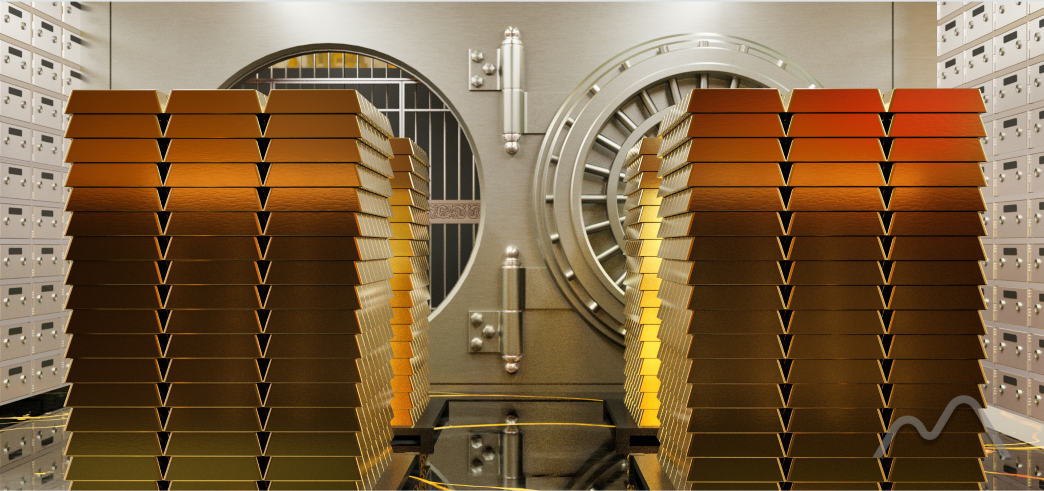
Gold reserves are held in highly secured vaults, often spread across multiple locations to mitigate risk. Well-known storage facilities include:
Some countries hold part of their gold abroad for liquidity or trading purposes, while others repatriate their reserves to ensure national control.
The term “gold reserves” is often confused with other gold metrics. For clarity:
| Term | Meaning |
|---|---|
| Gold reserves | Official gold holdings owned by central banks or other monetary authorities. |
| Gold production | The amount of gold mined annually by mining companies. |
| Gold in the ground | Estimates of natural, technically and economically recoverable gold resources; not part of a central bank’s official holdings. |
The distribution of global gold reserves reveals a great deal about economic stability, geopolitical power and monetary strategy. For now, the top 10 is still largely made up of Western economies, supplemented by countries that have deliberately strengthened their gold position in recent years.
This ranking is based on the latest figures from the IMF and the World Gold Council, combined with trends in central bank reporting.
| Country | Official gold reserves (tonnes) | % of global total | Annual gold production (tonnes) | Estimated in-ground gold resources (tonnes) |
|---|---|---|---|---|
| United States | 8,133 | 17% | 10 | 3,000+ |
| Germany | 3,352 | 7% | 1 | Limited |
| Italy | 2,452 | 5% | 1 | Small |
| France | 2,437 | 5% | 1 | Small |
| Russia | 2,333 | 5% | 310 | 5,300+ |
| China | 2,226+ | 4% | 370 | 3,500+ |
| Switzerland | 1,040 | 2% | 5 | Limited |
| Japan | 846 | 1.5% | 10 | Limited |
Below is a detailed analysis of the ten countries that hold the largest official gold reserves.
With more than 8,100 tonnes of gold, the United States remains the largest holder of gold reserves in the world by a wide margin. The US gold reserve represents almost 17% of all gold held by countries.
Most of the gold is stored in:
This exceptionally large gold reserve is a legacy of the period when the US dollar was fully backed by gold. Although that system was abandoned in 1971, gold remains a strategic reserve in the United States, underpinning financial and geopolitical confidence.
Germany holds the largest gold reserve in Europe. After the euro crisis, the Bundesbank repatriated approximately 674 tonnes of gold from the United States and France to gain more control over the national strategic reserve.
Gold serves several important functions for Germany:
Although Italy regularly faces economic pressure, it remains one of the world’s largest gold holders. Banca d’Italia emphasises that gold is an “ultimate anti-cyclical instrument” that is independent of financial markets and political decision-making.
The sizeable gold reserve supports confidence in Italy’s public finances, despite its relatively high debt burden.
France holds an amount of gold similar to Italy. The Banque de France considers gold a strategic component of its balance sheet, partly due to gold’s high liquidity and its ability to preserve value during periods of inflation.
France sells hardly any gold, thereby strengthening the continuity and stability of its monetary reserves.
Russia’s gold reserves have grown explosively over the past decade. Due to international sanctions and geopolitical tensions, Russia has deliberately focused on:
Russia is also one of the world’s largest gold producers, which makes it relatively easy for the central bank to keep adding domestically mined gold to its reserves.
China reports its gold reserves irregularly, which means that the true level may be higher than official figures suggest. The recent waves of purchases by the People’s Bank of China are part of a clear long-term strategy:
China is also the world’s largest gold producer, which supports the continued growth of its national reserves.
Switzerland holds a relatively small amount of gold compared to the size of its economy, but the country’s role in the global refining and storage industry is unique. A large share of the world’s gold is either processed or stored in Switzerland.
Swiss gold offers:
In 2021, Japan sold a small portion of its gold reserve to help finance COVID-19 support packages, but despite that sale, the country remains one of the larger holders of gold. The Bank of Japan views gold as a useful diversification tool alongside its substantial domestic bond holdings.
India has been aggressively increasing its gold reserves in recent years. The Reserve Bank of India adds significant volumes annually in order to:
Gold also plays a major cultural and economic role in India, making the total gold market (including private holdings) one of the largest in the world.
The Netherlands has maintained a stable position in the top 10 for many years. De Nederlandsche Bank stores part of the gold in the Netherlands and another part abroad, including at the Federal Reserve in New York and the Bank of Canada.
DNB explicitly describes gold as an “anchor of trust” and as a reserve asset that can be made liquid quickly in extreme scenarios.

A large part of the United States' gold is stored at Fort Knox.
The amount of gold a country produces annually says a lot about its economic position and the future availability of gold on the world market. Countries with high gold production typically have large natural resources, a mature mining industry and strategic interests in the global commodities market.
For investors and analysts, it is therefore important to understand which countries produce the most gold and how that production relates to their official gold reserves.
The table below is based on the latest USGS data and shows where most gold is currently mined worldwide.
| Rank | Country | Annual gold production (tonnes) |
|---|---|---|
| 1 | China | ~370 |
| 2 | Australia | ~310 |
| 3 | Russia | ~310 |
| 4 | Canada | ~200 |
| 5 | United States | ~170 |
| 6 | Kazakhstan | ~130 |
| 7 | Mexico | ~120 |
| 8 | Indonesia | ~110 |
| 9 | South Africa | ~100 |
| 10 | Peru | ~95 |
In addition to the official gold reserves held by central banks, the amount of gold still in the earth plays an important role in the global gold market. These so-called natural gold reserves are estimates of how much gold is economically and technically recoverable, based on geological data.
They show where future production will likely come from and which countries will maintain a strong long-term position in global gold supply.
Below are the countries with the largest mineable gold reserves according to the latest USGS data.
| Country | Estimated natural gold reserves (tonnes) |
|---|---|
| Australia | ~11,000 |
| Russia | ~5,300 |
| South Africa | ~5,000 |
| China | ~3,500 |
| United States | ~3,000 |
| Peru | ~2,700 |
In recent years, demand for gold from central banks worldwide has increased significantly. Since 2018, official gold purchases have been at their highest level in more than fifty years.
The explanation lies in a combination of economic uncertainty, geopolitical shifts and the unique properties of gold as an independent and universally valued asset.
Key reasons include:

The United States, Germany and Italy have the largest goldreserves worldwide.
Countries benefit directly in international trade when they hold substantial gold reserves. These reserves enhance financial credibility, making international trade relationships more reliable.
Gold can also serve as collateral when securing international loans and contributes to more stability in financial transactions.
For other countries and international institutions involved in trade and investment, gold provides additional assurance. Large gold reserves support the value of the national currency, which is important for maintaining both investor confidence and economic stability.
Gold therefore continues to play an important role in the international trading system and the global economy.
In view of ongoing economic uncertainty and geopolitical tensions, countries are likely to continue investing in gold reserves.
Emerging economies such as China and India, in particular, are building up their gold reserves to protect their currencies from exchange-rate risks and to become less dependent on the US dollar.
The future points to increasing demand for gold, not only from individual investors but also from governments that want to safeguard their financial security.
At The Silver Mountain you can buy physical gold in a simple, secure and transparent way. Our range consists of LBMA-certified gold bars and globally recognised gold coins sourced directly from official suppliers.
Orders are shipped discreetly and fully insured, or securely stored through Edelmetaal Beheer Nederland. Thanks to our buy-back guarantee and many years of experience, you can always count on reliability and professional guidance with every purchase.
The global gold market is shaped by three main factors: countries’ official gold reserves, their annual gold production and the size of their natural in-ground resources. The top 10 reveals a clear division between traditional economic power blocs and emerging powers such as China and Russia.
Central banks continue to buy gold as protection against inflation, geopolitical risks and currency volatility. For investors, this underlines the enduring strategic value of physical gold as a foundation within a diversified portfolio.
The Silver Mountain does not provide investment advice, and this article should not be regarded as such. Past performance is no guarantee of future results.
The United States holds by far the largest official gold reserves, with more than 8,100 tonnes of gold. This strategic stock has been maintained for decades as a cornerstone of the country’s financial system. The size of the US gold position strengthens international confidence in both the US dollar and the American economy.
Differences in gold reserves are driven by historical factors, economic strength and strategic choices. Western countries built up large reserves during the era of the gold standard, when currencies were linked to gold. By contrast, countries such as China and Russia have been actively buying gold in recent years to diversify their reserves and reduce dependence on the US dollar.
China, Australia and Russia are the largest gold-producing countries and together account for a significant share of global supply. Their strong mining sectors and rich geological deposits provide a relatively stable flow of newly mined gold. As a result, these countries are likely to remain highly influential in the international gold market for the long term.
Yes, but not every country reports with the same level of transparency or frequency. Western countries typically publish data monthly, while nations such as China and Russia update their figures less regularly. Changes in reported gold reserves result from purchases, sales and internal reallocations within the central bank’s balance sheet.
High gold production usually indicates rich geological resources and a well-developed mining sector. This strengthens a country’s economic position and secures long-term access to gold. Major producers tend to remain key players in the global supply chain and often pursue strategies to build or support their own gold reserves.
Indirectly, yes. Large underground gold reserves provide insight into potential future supply, but actual production does not automatically rise because developing new mines is costly and complex. In practice, the gold price is driven mainly by demand, geopolitical developments and monetary trends, while natural reserves primarily shape the long-term outlook for supply.
Central banks have been expanding their gold positions to protect themselves against inflation, geopolitical tensions and currency risks. Gold acts as an independent, globally accepted reserve asset without counterparty risk. The increasing demand from central banks shows that many countries are seeking security in an asset that is not dependent on foreign currencies or the stability of other financial institutions.
Rolf van Zanten is the founder and owner of The Silver Mountain, a specialist in physical precious metals since 2008. With nearly twenty years of experience in the precious metals trade, Rolf shares his expertise on investing in gold, silver, and platinum in an accessible and reliable way. His knowledge of the international gold and silver markets helps investors make well-informed decisions. In his role as an expert, he strives to ensure that transparency, security, and trust are at the heart of every purchase.

Be the first to discover the latest products and the latest news about precious metals.



 Nederlands