
 Buy gold bars
 Buy gold coins
 Series
 Buy silver coins
 Buy silver bars
 Series
 Buy silver collectible coins
 Silver collectible coin series
 Buy gold collectible series
 Gold collectible coin series
 Delivery
 Delivery service - From Wednesday delivered

 Pick up

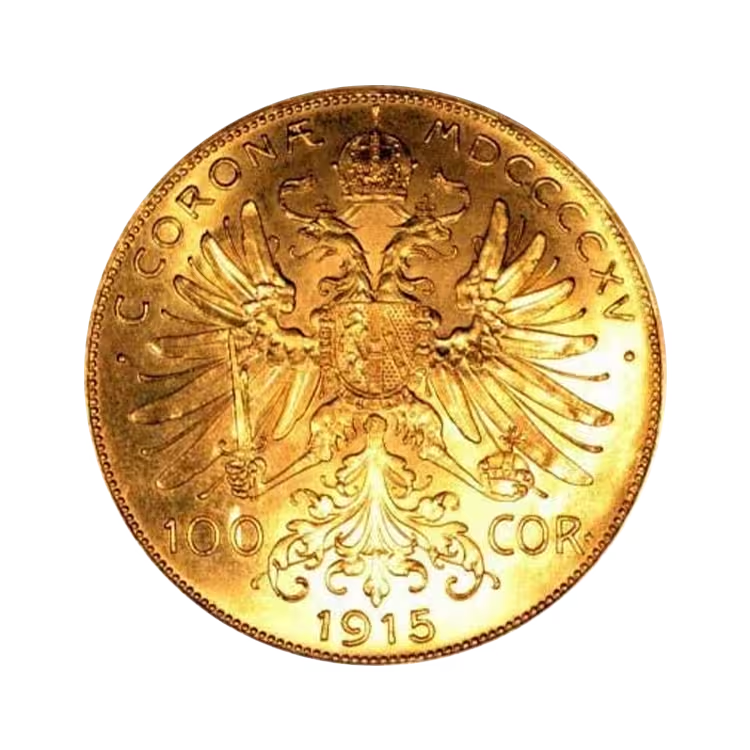
image and year as an indication


-
 Securily packaged
-
Buy back guarantee
-
Tradable world wide
-
Customer rating: 9.7
The Gold 100 Coronas coin from Austria is a rare coin containing 90% gold, minted between 1908-1915. The coin is a valuable piece of Habsburg history and a desirable collector and investment item.
Related products
- Pre-owned
- Bestseller

- Pre-owned
- Bestseller


- Mint condition

- Pre-owned
- Bestseller


Specifications
-Ps6WeWjJ.svg)
Physical properties
Net weight

The net weight is determined by multiplying the gross weight with with the purity. |
30,48 gram |
| Purity and metal type | 90% | Gold |
| Gross weight | 33,87 gram |
Origin
| Country of origin | Austria |
| Mint | Münze Österreich |
| Year of issue | Mixed years |
Price properties
| Selling price | € 3.645,00 |
| Metal worth | € 3.557,87 |
|
Price per gram
The price per gram is determined by dividing the sales price by the net weight. |
€ 119,57 |
|
Premium
The premium is determined by substracting the metal worth and possible taxes from the sales price. |
€ 87,13 |
| Investment score | B-label |
| VAT-rate | Investment gold |
Other specifications
| Pick up possible | Yes |
| Storage possible | Yes |
| Availability | In stock |
Information
Gold 100 Corona coin Austria
Discover the gold 100 Corona coin from Austria, a unique piece that reflects the rich history of the Austro-Hungarian Empire. This coin was first minted between 1908 and 1915 to commemorate the 60th anniversary of Emperor Franz Joseph I’s reign and has since become a cherished item among collectors and investors worldwide.
About the 100 Corona Gold Coin
The 100 Corona coin is more than just a gold coin; it is a tribute to the Austrian tradition of meticulous coin minting. The obverse of the coin features a detailed portrait of Emperor Franz Joseph I, while the reverse is adorned with the iconic double-headed eagle of Austria. The coin is made of 30.49 grams of gold with a purity of 98% (0.980 fineness).
The Austrian gold 100 Corona coin has a diameter of 37.1 mm and a thickness of 2.3 mm. Minted in Austria, the 100 Corona gold coin is one of the most renowned historical gold investment coins.


Price chart
Münze Österreich
Münze Österreich, also known as the Austrian Mint, is an Austrian mint responsible for producing Austria's currency. It is a global player in the international coin industry and is renowned for its impressive collectible coins, which are supplied to many countries worldwide. In their beautiful building in Vienna, they combine craftsmanship with tradition, creating stunning coins using cutting-edge technologies. Many of these coins are developed by their in-house numismatic experts. Coins from Münze Österreich are highly sought after by both investors and collectors.
In addition to minting coins, Münze Österreich supplies planchets to other countries. Planchets are discs of silver or gold used to make coins. Since 1989, Münze Österreich has been owned by the Austrian National Bank and produces around 450 million coins annually.
 Investment score
A B-rating indicates products that are still widely recognized and tradable worldwide, often issued by reputable mints or refiners. However, the price per gram or spread is generally slightly higher compared to A-rated products. While still suitable for investment purposes, they are not the most cost-efficient option available.
Label information A-label
Read more
Less information
A-label
Read more
Less information
Products with an A-rating are among the most commonly traded and liquid options available. These coins and bars offer a strong balance between a competitive price per gram and a low spread, making them well-suited for investors who want to acquire physical gold or silver efficiently. Due to their global recognition, they are typically easy to buy and sell.
B-label
Read more
Less information
Een B-label staat voor producten die wereldwijd goed verhandelbaar zijn en afkomstig zijn van erkende munthuizen of raffinaderijen. De prijs per gram of de spread ligt echter doorgaans iets hoger dan bij A-label producten. Daarmee zijn ze nog steeds geschikt als belegging, maar minder optimaal voor wie puur kijkt naar kostenefficiëntie.
 C-label
Read more
Less information
C-label
Read more
Less information
Products with a C-rating are primarily valued for their collectible characteristics. This may include limited editions, unique designs, or historical significance. As a result, their price is often less closely tied to the underlying metal value. These products are typically chosen by collectors rather than investors focused on efficiency.


 Nederlands